
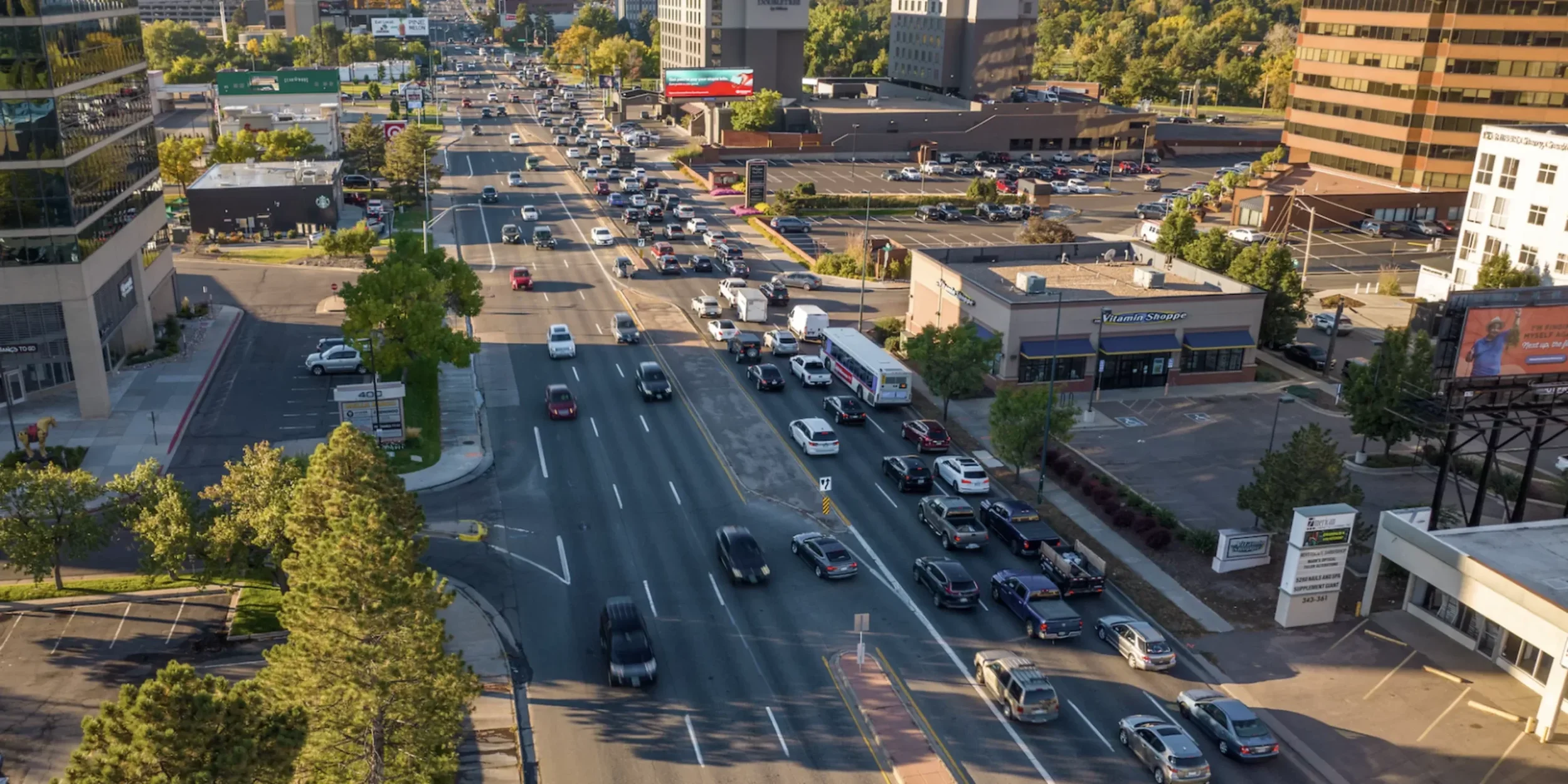
CDOT is proposing a Bus Rapid Transit system
along 7 miles of Colorado BLVD —from 40th AVE to Hampden AVE—
at a cost of up to $300 million
A decision on which alternative to build is expected this summer, before the Colfax BRT has carried a single passenger and before traffic modeling is complete. According to CDOT's own data, the most aggressive option would double southbound commute times for drivers. The City of Glendale has already voted unanimously to recommend No Build. Below are the questions Denver residents are asking — and the answers CDOT isn't leading with.
What is the Colorado blvd. BRT?
-
The Colorado Boulevard Bus Rapid Transit project is a proposal by the Colorado Department of Transportation (CDOT) — in partnership with RTD, the City and County of Denver, Arapahoe County, the City of Glendale, and the Denver Regional Council of Governments — to install a Bus Rapid Transit system along a 7-mile stretch of Colorado Boulevard from 40th Avenue to Hampden Avenue.
BRT is a bus system designed to mimic some features of light rail: dedicated lanes, fewer stops, pre-boarding fare payment, and enhanced stations. The project is currently in the alternatives analysis phase, meaning no final design has been chosen. But CDOT plans to select a preferred alternative this summer — before construction on the Colfax BRT is even complete, and before anyone knows whether that project actually works.
Source: https://www.codot.gov/projects/studies/denvermetrobrt/coloradoblvd
-
CDOT has narrowed the project to four alternatives:
Alternative 1 — Mixed-Flow BRT: The bus shares lanes with all other traffic. No dedicated bus lanes are added. Least disruptive to drivers but offers the weakest improvement in bus reliability.
Alternative 2 — Side-Running BRT: A dedicated bus lane is added along the sides of the road. Other vehicles may still use it for business access and right turns. Removes a travel lane from general traffic.
Alternative 3 — Center + Side Running BRT: A bus-only lane runs down the center of Colorado Boulevard for much of the corridor. The most aggressive option — removes the most lanes, creates the greatest disruption for drivers, businesses, and side streets. According to CDOT's own data, this option would double southbound commute times for drivers traveling the full corridor — from roughly 25 minutes today to about 50 minutes.
No Build — Existing Route 40: Colorado Boulevard stays as it is. The existing Route 40 bus continues without dedicated lanes or BRT improvements. This is the option Keep Denver Moving supports — and the one we're urging you to select on CDOT's survey.
Source: https://www.cbsnews.com/colorado/news/glendale-rejects-colorado-boulevard-bus-rapid-transit/escription
-
Longer commutes, fewer lanes, and traffic pushed into your neighborhood. CDOT's own data shows the center + side running alternative would double southbound commute times — from about 25 minutes to roughly 50 minutes for the full corridor. Even less aggressive alternatives would remove travel lanes and push overflow traffic onto parallel residential streets. We've already seen this play out on Colfax, where Denver's own BRT Program Director admitted to City Council that diverted traffic flooding into neighborhoods is "an unfortunate circumstance" and that "there's a limited amount that we can do." Expect the same on Colorado Boulevard.
Source: https://www.cbsnews.com/colorado/news/glendale-rejects-colorado-boulevard-bus-rapid-transit/
-
CDOT plans to select a preferred alternative in Spring/Summer 2026. If a build alternative is chosen, 30% design documents would follow by Spring 2027.
Here's the problem: that decision will be made before the Colfax BRT carries a single passenger. Colfax — Denver's first-ever BRT, currently under construction — won't complete revenue service until mid-2027 at the earliest. CDOT is asking Denver to commit to repeating an experiment before the results of the first experiment are even in. Traffic modeling for Colorado Boulevard is also incomplete. Choosing a preferred alternative this summer means making a multi-hundred-million-dollar decision based on projections, not evidence.
Source: https://denverite.com/2026/05/14/colorado-boulevard-brt-plan/ Source: https://www.codot.gov/projects/studies/denvermetrobrt/coloradoblvd
-
According to CDOT's own data, approximately 2,800 people ride buses along the Colorado Boulevard corridor each day. CDOT projects that number could grow to around 6,000 daily riders under a BRT system — a projection that conveniently doubles ridership. Keep in mind: this forecast comes from the same agency proposing the project, using the same type of modeling that has consistently over-promised ridership on BRT projects across the country. Meanwhile, RTD system-wide ridership remains 39% below pre-pandemic levels. The idea that a new BRT line will suddenly double ridership on this corridor deserves serious scrutiny.
Source: https://www.cbsnews.com/colorado/news/glendale-rejects-colorado-boulevard-bus-rapid-transit/
-
If Colfax is any guide — a lot of pain, and very little help. On Colfax, businesses reported 20–50% drops in revenue. Legacy restaurants closed permanently. The city's entire business mitigation fund for a 10-mile corridor was $2.8 million — a one-time grant of up to $15,000 per business that owners publicly called "a wet Band-Aid." CDOT says it will "work to minimize impacts to businesses during construction" on Colorado Boulevard and maintain access during operating hours. That's the same promise that was made on Colfax.
Source: https://www.codot.gov/projects/studies/denvermetrobrt/coloradoblvd/frequently-asked-questions
Source: https://www.westword.com/news/denver-residents-brt-construction-options-colorado-blvd-40885066/
-
Glendale — which sits along approximately 1 mile of the corridor — has already made its position crystal clear. The Glendale City Council voted unanimously to recommend "No Build." Glendale's City Manager Chuck Line put it bluntly: "Hell no." Glendale's concerns include increased congestion, longer red lights on east-west cross streets creating backups on parallel roads, and business community impacts that they believe far outweigh any projected ridership gains. Glendale also sent an eight-page letter to CDOT with detailed concerns — and says they never heard back.
Source: https://www.cbsnews.com/colorado/news/glendale-rejects-colorado-boulevard-bus-rapid-transit/
Source: https://www.westword.com/news/denver-residents-brt-construction-options-colorado-blvd-40885066/
-
Up to $300 million — depending on which alternative is selected. Here's what makes that number even more troubling: CDOT has only secured funding for the design phase. Not construction. That means if a build alternative is chosen, hundreds of millions of dollars in construction funding would still need to be identified and secured. Denver residents could be locked into a preferred alternative before anyone has figured out how to pay for it.
Source: https://denverite.com/2026/05/14/colorado-boulevard-brt-plan/
-
The project is led by CDOT and developed in collaboration with RTD, the City and County of Denver, Arapahoe County, the City of Glendale, and DRCOG. It is part of CDOT's 10-Year Vision Plan and one of 11 designated BRT corridors in the DRCOG 2050 Regional Transportation Plan. Federal funding through the Bipartisan Infrastructure Law is expected to play a role — which is why the project must comply with the National Environmental Policy Act (NEPA). Put simply: multiple layers of government, regional planning bodies, and federal funding streams are all pointing in the same direction. The question is whether the community's voice is loud enough to change course.
Source: https://www.codot.gov/projects/studies/denvermetrobrt/coloradoblvd
-
The official CDOT project page is at: https://www.codot.gov/projects/studies/denvermetrobrt/coloradoblvd
CDOT's active public survey — where you can select No Build — is at: https://www.codot.gov/projects/studies/denvermetrobrt/coloradoblvd/alternative-survey
Read it. Then take the survey and select No Build.